Bring La Dolce Vita to Your Designs
There’s a certain magic to Italy that’s hard to put into words. It’s in the curve of a gondola slicing through Venetian canals, the chaotic beauty of a bustling Roman piazza, or the simple perfection of a lemon grove on the Amalfi Coast. Capturing that feeling—that specific, sun-drenched, deliciously relaxed spirit—is a challenge for any designer. You could use stock photography, but it often feels generic. You could try illustration, but it’s time-consuming. What if you had a toolkit of charming, hand-drawn elements that instantly evoked the romance, flavor, and adventure of Italy? That’s exactly the world this collection invites you into.
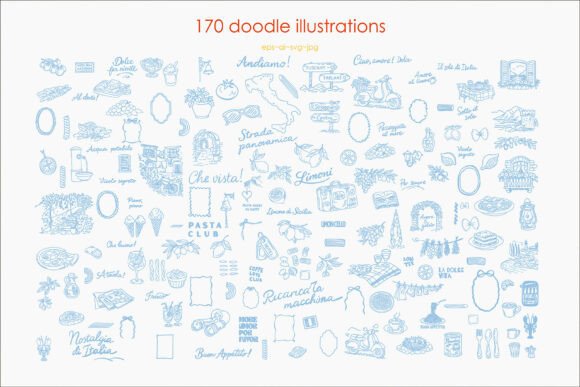
This isn't just another set of vector graphics. It’s a curated mood board in illustration form, designed to solve a very real problem for creatives. How do you make a project feel authentically Italian without resorting to clichés? The answer lies in the details: a doodle of a Vespa that looks like it was sketched in a travel journal, a frame made of olive branches that feels organic and welcoming, or a hand-lettered “Ciao” that carries the warmth of a greeting from a friend. These elements work because they’re rooted in observation and affection for the subject, providing a shortcut to emotional resonance for your audience.
More Than Clip Art: A Toolkit for Authentic Storytelling
The true value of a design asset library like this lies in its versatility. Think of it as a Swiss Army knife for your creative projects. With 170 individual elements, you’re not locked into a single aesthetic. Instead, you have a vocabulary to tell different Italian stories. Need to design a rustic wedding invitation? Combine the botanical lemon and olive branch illustrations with elegant script typography. Launching a boutique pasta brand? The playful doodles of pizza, gelato, and wine bottles can become the foundation of your packaging and social media identity. The collection is built for mix-and-match creativity, allowing you to build unique visual narratives for every client or personal project.
Consider the practical applications across different mediums:
- Brand Identity & Logo Design: Use a single iconic element—a stylized Colosseum or a charming gondola—as a memorable mark. Pair it with a complementary serif font or script font for a complete logo system that feels both professional and full of character.
- Packaging & Merchandise: For a food product, restaurant, or café, these doodles transform labels, boxes, and menus into an experience. Imagine a limoncello bottle adorned with a delicate lemon branch illustration, or a café’s takeout bag featuring a doodle of a steaming espresso cup.
- Digital Presence: Break the monotony of your website or blog. Use the decorative frames to highlight quotes or testimonials, and scatter the travel icons throughout your site to create a cohesive visual journey for visitors. These elements can make web design feel more personal and engaging.
- Social Media & Marketing: Create a consistent Instagram aesthetic. Use the hand-drawn elements as overlays on photos, as part of story templates, or to design eye-catching post graphics. The whimsical style is inherently shareable and helps build brand recognition in a crowded feed.
Finding the Right Balance: Whimsy Meets Professionalism
The line between charming and chaotic can be thin. A key strength of this particular set is its cohesive hand-drawn style. Every element shares a similar line weight, level of detail, and playful energy. This visual consistency is crucial for brand identity. When you use a doodle from this collection on your website, and the same style on your business card, you’re reinforcing a unified brand personality. It tells your audience that you pay attention to details and value a specific, curated aesthetic.
However, whimsy needs a counterpoint. The most effective designs often pair these playful illustrations with clean, legible typography. This is where understanding font pairing becomes essential. A highly decorative handwritten font used for body text would be a nightmare to read. Instead, consider using the hand-drawn elements as accents against a backdrop of a simple sans serif font for clarity. Reserve a more expressive display font or script font for headlines, where it can make a statement without compromising readability. The goal is to let the illustrations tell the story while the typography provides clear, accessible information.
Practical Considerations for Seamless Integration
Before diving into a project, a quick review of the file formats (EPS, AI, SVG, JPG) is worthwhile. The vector formats (EPS, AI, SVG) are your best friends for scalability. You can resize a doodle of the Colosseum to fit on a poster or shrink it down for a favicon without any loss of quality. They also allow for easy color customization to match your specific brand palette. The JPGs are perfect for quick use in digital documents or social media posts where vector editing isn’t necessary.
Finally, always consider the context. A travel blogger might use these elements to map out a itinerary in a blog post, creating a visual guide that’s more engaging than text alone. A small winery could use the wine bottle and grape illustrations to design a tasting note sheet that feels artisanal. The applications are limited only by your imagination. The key is to use these assets not as a crutch, but as a catalyst—to spark ideas that are uniquely yours and deeply connected to the timeless allure of Italy.
In a digital landscape saturated with sterile graphics and overused templates, injecting a dose of hand-crafted personality is a powerful move. It signals authenticity, care, and a connection to tradition—qualities that resonate deeply in branding and design. Whether you’re crafting a full identity for an Italian restaurant or simply want to add a touch of Mediterranean charm to your next personal project, having a versatile toolkit of illustrations can be the difference between a generic result and one that truly feels like la dolce vita.