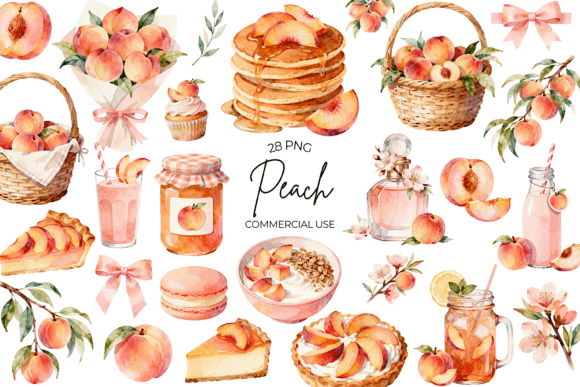
Watercolor Peach Clipart: Sweeten Your Summer Designs
There’s something undeniably cheerful about a ripe, juicy peach. Its soft, fuzzy skin and gradient of sunset colors evoke lazy summer afternoons, fresh-from-the-oven pies, and the simple sweetness of the season. Capturing that feeling in a design project can instantly make it feel warmer, more inviting, and full of life. This is precisely where a thoughtfully curated collection of watercolor peach illustrations becomes an invaluable asset for any creative toolkit. Imagine having 28 high-quality, ready-to-use images at your fingertips—peaches nestled in baskets, transformed into jam jars, decorating pancakes, or paired with delicate floral accents. This bundle isn't just about fruit; it's about bottling a specific, joyful aesthetic.
Beyond the Fruit: A Visual Language for Your Brand
While the core subject is summer fruit, the applications for this type of Watercolor Peach Clipart extend far beyond literal depictions. The watercolor style itself is a powerful design language. It communicates approachability, artistry, and a handcrafted quality. For a small business owner, this translates directly into brand personality. A local bakery could use these illustrations on packaging and social media to reinforce its homemade ethos. A wedding planner specializing in garden parties might find the perfect accent for invitation suites and day-of signage. The soft textures and organic shapes avoid the sterility of vector graphics, adding a human touch that resonates with audiences seeking authenticity.
Consider the practical versatility. The transparent backgrounds and high resolution (3600×3600px at 300 DPI) mean these assets are ready for serious work. They can be scaled for large-format posters or printed on delicate tissue paper for product packaging without losing quality. For digital creators, they become the foundation for Instagram story templates, Pinterest pins that stand out in a feed, or website headers that immediately set a seasonal tone. The collection’s variety—from fresh fruit to prepared foods—allows for storytelling. You could design a entire cohesive marketing campaign for a summer menu launch, using the peaches, pies, and jam to create a narrative arc from fresh ingredient to delicious result.
Practical Pairings: Integrating Clipart into Your Workflow
Having beautiful assets is one thing; using them effectively is another. The key to professional integration is thoughtful pairing and composition. These watercolor elements work beautifully alongside clean, simple typography. A modern sans-serif font provides a crisp counterpoint to the organic brushstrokes, ensuring readability for important information like event details or product descriptions. Alternatively, a elegant script font can complement the artistic style for headlines or monograms, creating a seamless, feminine aesthetic.
For logo design or brand identity projects, think of the clipart as an accent rather than the entire logo. A single, perfectly placed peach or a small cluster of blossoms can add a unique signature mark to a wordmark. In packaging design, they can be used as pattern repeats on wrapping paper, spot illustrations on labels, or decorative borders. The key is to maintain visual consistency. Choose a few favorite elements from the bundle and use them repeatedly across all your touchpoints—website, business cards, social media—to build a recognizable look. This repetition helps with brand recognition and creates a polished, professional presentation.
From Screen to Print: Ensuring Flawless Execution
The true test of any design asset is its performance in the real world. Because these PNGs are provided at a high resolution, they are suitable for both digital and print applications. When preparing files for a commercial printer, ensure you embed the images and use a CMYK color profile to get the closest match to the on-screen watercolor hues. For digital use, the transparent backgrounds make layering in design software like Canva, Adobe Photoshop, or Illustrator straightforward. You can easily place them over photos, patterned backgrounds, or solid colors without worrying about awkward white boxes.
A pro tip for content creators and marketers: use these illustrations to create a library of reusable graphics. A single peach image can become a social media icon, a bullet point in a blog post, a watermark on a photo, or part of a larger collage. This approach saves time and ensures all your content has a unified aesthetic. For those selling digital products—like planners, worksheets, or printable art—incorporating these unique illustrations can significantly increase perceived value and help your offerings stand out in a crowded marketplace.
Choosing Your Style: A Guide to Visual Harmony
Not every project calls for the same level of detail. The bundle’s variety allows you to select the right element for the job. A simple, single peach might be perfect for a subtle favicon or a delicate accent on a website menu. A more complex scene, like peaches in a basket with floral accents, could serve as the hero image for a printed poster or the cover of a recipe booklet. When deciding, always consider the context and the medium. A busy, detailed illustration might get lost when printed very small, while a simple, bold one might lack impact on a large format.
Always test your chosen clipart within the actual layout. Does it compete with the typography? Does the color palette clash or complement your brand colors? Sometimes, desaturating the illustration slightly or applying a subtle overlay can help it integrate better with a minimalist design. The goal is for the watercolor peach clipart to enhance your message, not distract from it. By viewing these assets as versatile tools rather than just pretty pictures, you can unlock their full potential to create designs that are not only beautiful but also strategically effective, engaging your audience and elevating your projects with the sweet, unmistakable essence of summer.